Signed in Glass and Paint: The Roadside Artists Giving Small-Town America Its Face Back
Drive long enough through the middle of this country and you start to notice what's missing. Strip malls that could be in Ohio or Arizona. Franchise fonts on every window. A visual sameness so complete it starts to feel like a kind of erasure — like the place itself never had anything particular to say.
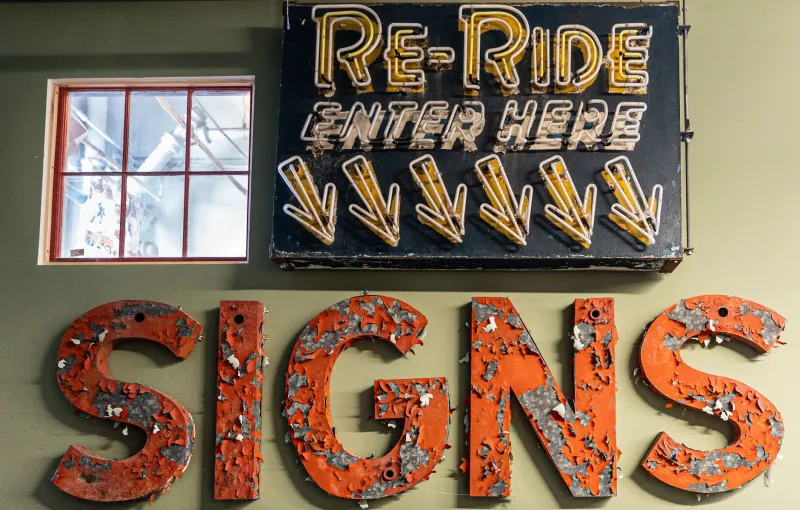
Then, somewhere off the interstate, you catch it. A sweep of hand-painted letters above a hardware store. A buzz of pink neon in a diner window, bending into a cursive script that no algorithm designed. And for a second, the town has a face again.
The Weight of a Brush
Robert Earl Tatum III has been painting signs in Clarksdale, Mississippi, since he was eleven years old, watching his grandfather steady a script brush against a wooden panel in a shed behind the house. He's fifty-four now. His hands are the same shape as his grandfather's in the photographs.
"People think this is a dying thing," he says, cleaning a brush with a rag that's been stained every color imaginable. "But dying things don't get phone calls from thirty states."
He gets those calls — from restaurant owners who want something that looks like it belongs to them, from bar owners tired of ordering signs off a website and getting back something that could hang anywhere. Tatum charges more than a vinyl cutter would cost. People pay it anyway.
His work is slow by design. A single storefront sign can take three days. He lays out the lettering by hand, adjusting spacing by eye, mixing colors that don't exist in any swatch book. The result is something that carries the evidence of a human being having stood there and made a decision — about weight, about curve, about what this particular word should feel like on this particular wall.
"A vinyl wrap peels off," he says. "Paint becomes the building."
From Pixels to Plasma
About fifteen hundred miles west of Clarksdale, in a converted auto shop on the edge of Marfa, Texas, Diane Solis is doing something that looks like sculpture and sounds like a low, electric hum.
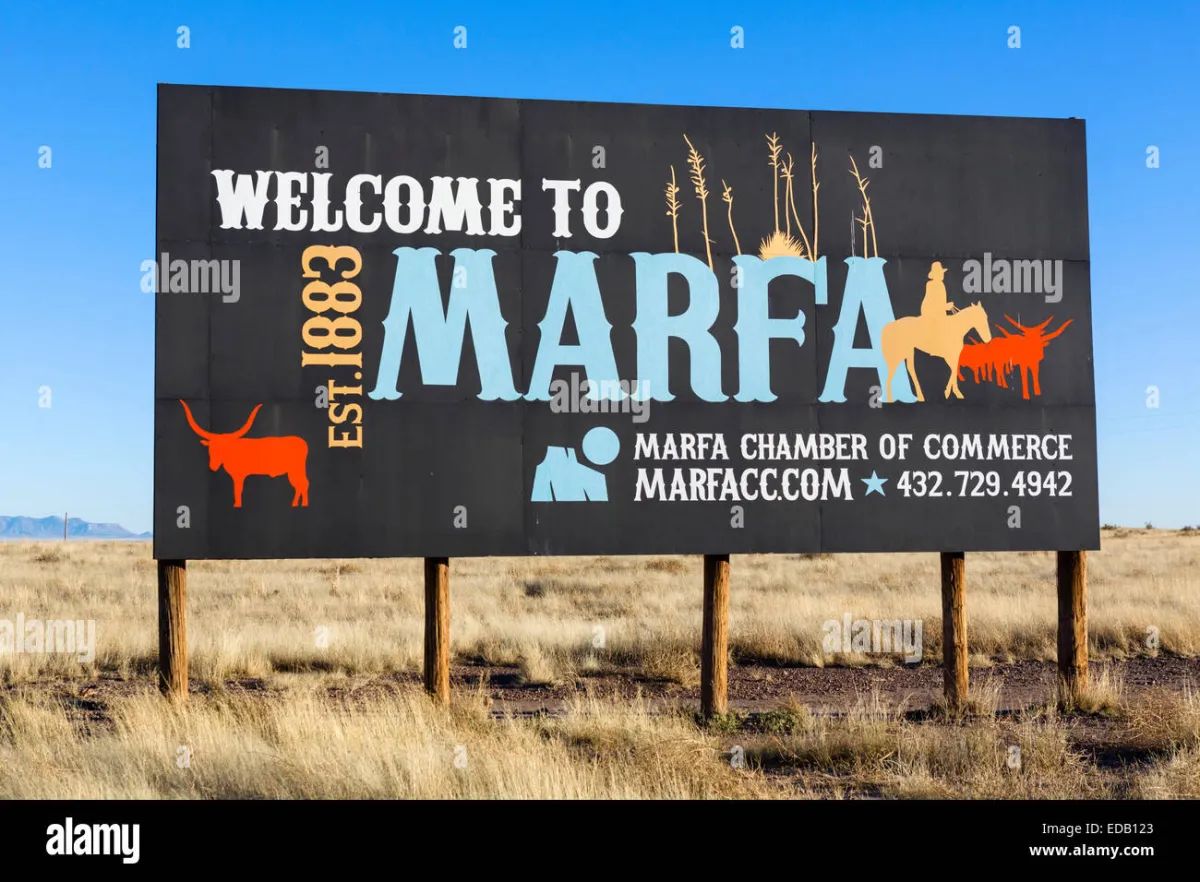 Photo: Marfa, Texas, via c8.alamy.com
She spent eight years as a UX designer in San Francisco. Good salary, good title, the whole thing. She quit in 2019, moved to the high desert, and started bending glass.
Neon work — real neon, the kind where argon or neon gas is sealed inside hand-shaped glass tubing — is a craft with almost no margin for error. The tubes are heated over a ribbon burner, shaped freehand, and cooled slowly. Crack the glass in the wrong place and you start over. Solis burned through hundreds of tubes her first year before she made anything she'd show anyone.
"I spent years designing things that were supposed to disappear," she says. "Interfaces that you move through without noticing. I wanted to make something you'd stop for."
Her signs glow in the windows of a coffee shop, a used bookstore, and a small motel that's been operating since 1962. Each one was designed in conversation with the owner — not handed a template, but asked: what does this place feel like at night?
A Signature, Not a Logo
There's a distinction both Tatum and Solis keep returning to, and it matters. What they make isn't branding in the way a marketing firm would use the word. It's closer to a signature — something that says this specific place exists, and it looks like this, and nobody else looks exactly like this.
In an era when small businesses increasingly rely on Canva templates and AI-generated logos that spit out something technically competent and completely generic, that distinction is starting to feel urgent to a growing number of business owners.
Jerome Whitfield opened a barbershop in Bowling Green, Kentucky, three years ago. He'd been cutting hair for twenty years and finally had his own place. His first instinct was to order a sign from an online print service. It came back looking like every other barbershop sign in America.
 Photo: Bowling Green, Kentucky, via wallpapercave.com
He found a local sign painter through a Facebook group dedicated to preserving hand-lettering trades. Paid three times what the print service charged. The painter spent two days on a ladder outside his shop.
"People pull over to look at it," Whitfield says. "I've had people come in just because of the sign. Not because they needed a haircut. Because they wanted to know who made it."
The Ones Coming Up
The craft isn't only in the hands of people who've been at it for decades. There's a loose apprenticeship culture forming — not in any formal sense, but through workshops, YouTube channels with small but devoted followings, and sign-painting meetups that draw people who drove four hours to watch someone letter a panel in real time.
Solis has started teaching weekend workshops out of her Marfa shop. Her last session sold out in forty-eight hours. Most of the attendees were under thirty-five. Several were, like her, people with design or tech backgrounds who'd spent years making things that lived only on screens.
"There's a hunger for the physical," she says. "Not nostalgia, exactly. More like — people want proof that something was made."
Tatum puts it differently, in the way he tends to put things: directly.
"Every town used to look like itself. Somebody decided that was inefficient. We're just deciding they were wrong."
The Road Keeps Reading
There's something quietly radical about driving past a hand-painted sign on a two-lane road and knowing that someone stood on a ladder and made every letter by hand. It doesn't ask you to feel nostalgic. It just asks you to notice that you're somewhere specific — that this town, this shop, this diner has a visual voice that belongs to it and nothing else.
In a country where so much of the roadside has been flattened into sameness, that's not a small thing. It's an argument, made in paint and glass and glowing gas, that a place deserves to look like itself.
Some arguments are worth making slowly, with a brush, over three days, on a wall that might outlast everyone involved.