Between the Pages: The Secret Notes Left in Library Books for Strangers to Find
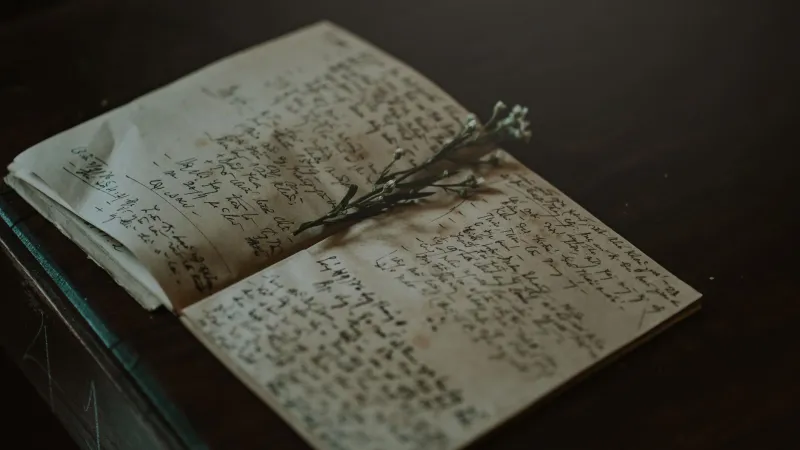
The note was tucked between pages 112 and 113 of a worn paperback copy of The Remains of the Day. It was written on a torn piece of brown paper bag, in handwriting that leaned slightly to the left, in blue ink that had faded just a little at the edges.
 Photo: The Remains of the Day, via pic.chinaz.com
I read this after my dad died. I don't know why I'm telling you that. I guess I just wanted someone to know it mattered. I hope it matters to you too.
No name. No date. Just those three sentences, folded once, waiting.
The person who found it — a woman named Priya, a librarian in her early fifties at a branch of the Chicago Public Library — kept it. She still has it. She's not sure she could explain exactly why, except that throwing it away felt wrong in a way that was difficult to articulate. "It felt like throwing away a piece of someone," she says. "Even though I had no idea who that someone was."
 Photo: Chicago Public Library, via vacationshuttle.com
A Tradition Without a Name
Across the country, in public libraries from small-town branches to sprawling urban systems, this practice has been quietly taking root. Readers are returning books with something extra tucked inside — handwritten notes, pencil sketches, pressed leaves and flowers, strips of paper with a single line of poetry, photographs with nothing written on the back. Small offerings left for the next reader, whoever they turn out to be.
Nobody organized this. There's no movement, no hashtag that started it, no viral moment that launched it into the mainstream. It seems to have emerged the way genuinely human things often do — gradually, independently, in a dozen different places at once, because the impulse behind it is old and simple: I was here. This meant something to me. Maybe it will mean something to you.
Librarians, who are perhaps the best-positioned people in America to notice what readers are actually doing, have been watching it happen for years.
"I find them a few times a month now," says James Whitfield, who works at a mid-sized public library in Asheville, North Carolina. "Sometimes it's just a little drawing. Sometimes it's a whole letter. I always read them before I decide what to do."
 Photo: Asheville, North Carolina, via www.fidji-paie.com
What he does with them varies. Some he leaves in the book, reasoning that they were put there to be found and found again. Others, particularly the ones that feel too personal — too raw, too exposed — he sets aside in a small box he keeps behind the circulation desk. He hasn't figured out what to do with those yet. He suspects he never will.
The Weight of Anonymous Intimacy
There's something specific about the anonymity that seems to be the point. These notes aren't signed. They're not meant to start a correspondence. They're more like messages in bottles — released without expectation, without any guarantee of being found at all, and certainly without any hope of a reply.
And yet that very quality is what makes them land so hard when you do find one.
"If someone told me that story to my face — about reading a book after losing their dad — I'd feel for them, but there'd also be all the social weight of the moment," says Dr. Elaine Cortez, a cultural anthropologist who studies community rituals and has been documenting this phenomenon informally for the past two years. "The note strips all that away. It's just the feeling, just the truth of it, sitting there waiting for you. There's nowhere to put your discomfort. You just have to receive it."
That directness, she argues, is part of why the practice feels so different from other forms of social sharing. We live in an age of performed vulnerability — the carefully worded Instagram caption, the podcast confession, the newsletter essay. All of it is real, but all of it is also shaped by audience awareness, by the knowledge that people are watching and responding. The library note has none of that. The writer will never know who found it. The reader will never know who left it. The exchange is pure.
"It's intimacy without the risk of intimacy," Dr. Cortez says. "Which sounds like a contradiction, but I think it's actually what makes it so moving."
What Gets Left Behind
The notes themselves are as varied as the people who leave them. Priya, the Chicago librarian, has collected a small archive of the ones she's found over the years. There's a hand-drawn map of someone's neighborhood with a star marking what the note describes as "the best bench in the city." There's a list of seven movies the writer says pair well with the book. There's a page torn from a journal with a single word written on it — finally — and nothing else.
Some are funny. Some are heartbroken. Some are so specific they feel almost too private to read, like stumbling into someone's diary by accident.
And some are addressed directly to the next reader — Hey, you or To whoever finds this — which creates a strange and lovely temporal fold. The writer is speaking to someone who doesn't exist yet. The reader is receiving a message from someone who has already moved on. The book is the bridge between them, holding the note in its pages like a secret it agreed to keep.
James, in Asheville, says the books that seem to accumulate the most notes are the ones that deal with grief, with loneliness, with the feeling of being fundamentally misunderstood by the people around you. A Grief Observed. The Bell Jar. Giovanni's Room. Books people often read alone, at difficult moments, without anyone to talk to about what they're feeling.
"People reach for those books when they need to feel less alone," he says. "And then they leave a note because they still need to feel less alone. It makes a lot of sense when you think about it that way."
The Library as Living Archive
What's easy to forget, in the age of e-readers and digital downloads, is that a physical library book has a history. It's been held by dozens of hands. It's been read in hospital waiting rooms and on back porches and in bed at two in the morning. It carries all of that, invisibly, in its worn spine and its slightly soft pages.
The notes make that history visible. They turn the book into something closer to a conversation — one that spans years, that crosses every kind of human boundary, that asks nothing except that you pay attention.
"That's what a library is, at its best," Priya says. "It's a place where stories keep finding each other."
She still has the note from The Remains of the Day. It lives in her desk drawer, folded the way she found it. She takes it out sometimes, not often, just when she needs to remember that someone she'll never meet once sat with a book and a loss and decided, for reasons they probably couldn't fully explain, to reach out into the future and leave something true.
She always puts it back. It feels right, keeping it close. Like being trusted with something small and irreplaceable.
Like being the next reader, and knowing it.