Pages That Hold Everything: The People Who Never Stopped Making Scrapbooks
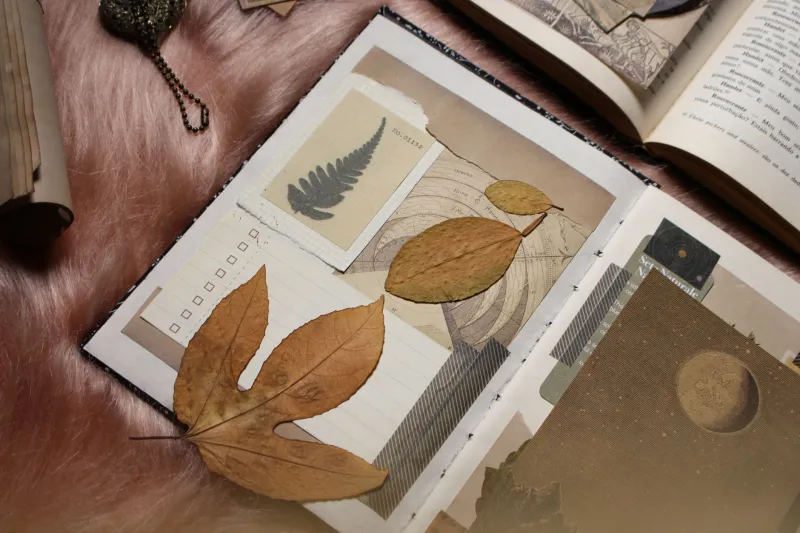
There's a shoebox under Marlene Okafor's bed in Columbus, Ohio, that contains thirty-seven years of ticket stubs, pressed flowers, birthday cards written in her grandmother's looping cursive, and a single dried-out pen that ran out of ink on the day she finished her first scrapbook at age eleven. She hasn't thrown any of it away. She hasn't digitized it either. That shoebox feeds the books — twelve of them now, each one a handmade chronicle of a life lived with intention.
"People ask me why I don't just use my phone," she says, lifting the cover of her most recent volume, a thick linen-bound thing stuffed with layered ephemera. "And I say — okay, show me your camera roll from five years ago. Can you even find it? Do you remember what any of it meant?"
She has a point. We are drowning in images and starving for meaning. And somewhere in that contradiction, scrapbooking — long dismissed as a suburban hobby involving sticker packs and acid-free cardstock — has quietly evolved into something that looks a lot like art.
Not Your Mom's Craft Corner
The cultural memory of scrapbooking is stuck somewhere around 2003: Creative Memories parties, die-cut machines, cheerful fonts spelling out "Family Vacation!!" above a grid of photos from Disney World. That version of the craft existed, and it still does, but it's only a fraction of what's happening now.
A growing community of makers — some trained in fine arts, others entirely self-taught — are approaching the handmade memory book as a serious narrative object. They're thinking about composition the way a photographer does, about sequence the way a filmmaker does, about texture and weight the way a sculptor does. The result is something that sits comfortably between personal archive and visual essay.
Denver-based artist Callie Reyes, whose scrapbooks have been exhibited at two independent galleries in the past three years, describes her process as "editing a life the way you'd edit a film." She doesn't include everything. She decides what matters, what earns its place on the page, what gets left in the shoebox. "Every choice is an argument," she explains. "When you put two images next to each other, you're saying something about how they relate. That's not craft. That's storytelling."
Her books incorporate archival family photographs alongside her own handwritten annotations, receipts, fabric swatches, and in one memorable spread, a piece of her late father's flannel shirt. The effect is visceral in a way that a digital slideshow simply cannot replicate. You can feel the weight of what's on the page.
The Hands Know What the Screen Doesn't
There's a body of thought — not entirely fringe — that physical engagement with memory changes the way we hold onto it. The act of choosing a photograph, trimming it, placing it against a particular background, and writing something next to it by hand forces a kind of attention that scrolling never demands. You can't do it passively.
Jamie Tran, a librarian and scrapbooker based in Austin, Texas, has been thinking about this for years. She leads informal workshops at her local branch library, mostly for adults who stumble in curious and leave three hours later, glue-sticked and converted. "When you're arranging something by hand, you're making hundreds of tiny decisions," she says. "And each one is a form of remembering. You're not just storing the memory — you're actively constructing it."
This idea — that curation is itself a creative act — is central to why so many people are returning to the form. In an era where every moment is automatically photographed and filed away by an algorithm, the deliberate selection involved in scrapbooking feels almost radical. You're saying: this mattered. This moment deserved more than a thumbnail.
Paper, Glue, and Something Like Grief
For many practitioners, scrapbooking is bound up with loss in ways that are hard to talk about but easy to understand once you're holding someone's finished book. The form has a long history as a grief practice — Victorian mourning albums, memory quilts, shadow boxes built around the possessions of people who are gone. That tradition hasn't faded.
After her mother died in 2021, Portland resident Sasha Whitmore spent eight months building a scrapbook from her mother's belongings: letters, grocery lists, a handwritten recipe for peach cobbler, photographs from decades before Sasha was born. "I didn't know what else to do with all of it," she says. "I couldn't throw it away, and I couldn't just stick it in a box. I needed to make it into something."
The resulting book — she calls it simply Mom — lives on her coffee table. She opens it the way some people open a journal, when she needs to feel close to someone who isn't there anymore. "No app does that," she says quietly. "No app sits there and waits for you."
The Community That Never Logged Off
Scrapbooking's online communities are, paradoxically, enormous. Forums, subreddits, Instagram accounts, and YouTube channels dedicated to the craft attract hundreds of thousands of followers. Hashtags like #scrapbooking and #memorykeeping pull up millions of posts. The people doing this are not hiding.
What's interesting is how the online and offline versions of the hobby feed each other. Creators share their pages digitally, get inspired by others' work, order supplies from small independent shops, and then retreat to their kitchen tables to do the actual work — alone, quiet, hands moving. The screen is a window into the community. The table is where the art happens.
Reyes, who posts her work regularly, is thoughtful about the distinction. "I'll share a finished spread online and people respond to it," she says. "But the experience of making it — that's not shareable. That's just mine."
Why It Matters Now
There's something almost countercultural about insisting that your memories deserve physical form. That they're worth the time and the mess and the deliberate attention. In a media landscape that rewards speed and volume, scrapbooking is irreducibly slow. You cannot rush a good page. You cannot batch-process a life.
Marlene Okafor closes her latest book carefully, running her hand across the cover the way you'd close a door gently so as not to wake someone. She's already thinking about the next one. "Someday somebody is going to find these," she says, "and they're going to know exactly who I was. Not just what I looked like. Who I was."
That's the promise of the form, and it's a pretty good one. Not every story needs to go viral. Some of them just need to be kept.