Before the Whitewash: The Amateur Archivists Saving City Walls From Oblivion
Somewhere in the Pilsen neighborhood of Chicago, a woman named Dara Fuentes woke up at 6 a.m. on a Tuesday because she'd heard a rumor. A building on 18th Street — the one with the massive portrait of a woman in a huipil, arms stretched wide, marigolds spilling from her hands — was going to be pressure-washed by the end of the week. Developers had bought the lot. The mural, painted sometime in the early 2000s by a local artist whose name nobody could quite remember, had maybe four days left.
She grabbed her camera and went.
"I got there before the light was even good," she says. "I just kept shooting. Every angle, every crack, every place where the paint had started to bubble. I wanted all of it."
Dara isn't a professional photographer. She's a middle school art teacher who started documenting murals almost by accident — she was walking home one afternoon and noticed a wall she'd passed a hundred times had been painted over. Beige. Just beige. Whatever had been there before was completely gone, and she had no idea what it was. That blankness bothered her in a way she couldn't shake.
She's not alone in that feeling.
The Ones Who Notice
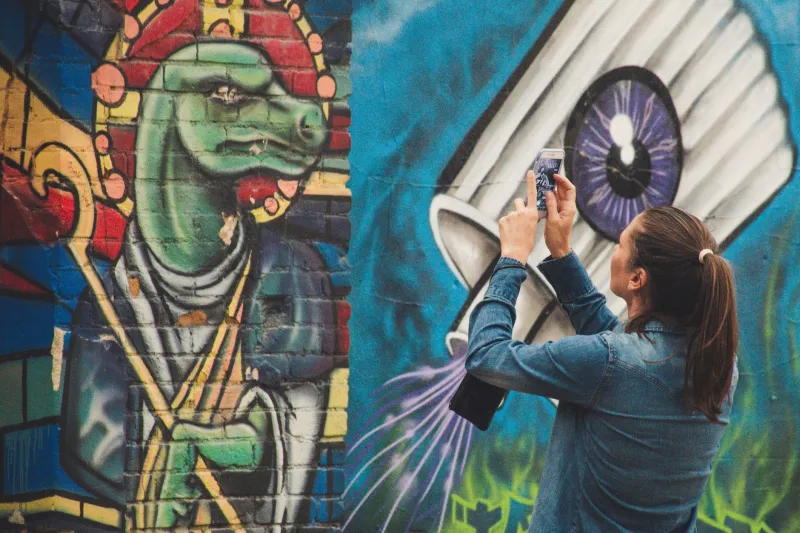
Across American cities — Los Angeles, Detroit, Philadelphia, Houston, New Orleans — there's a loose, largely informal network of people doing what Dara does. They carry cameras (or just really good phones), keep notebooks full of addresses and dates, and spend their weekends walking neighborhoods with their eyes tilted upward. Some of them have built Instagram accounts with tens of thousands of followers. Others keep private archives that no one but a few friends has ever seen. Most of them started the same way: they lost something and didn't want to lose anything else.
In Detroit, a retired postal worker named Calvin Briggs has photographed over 800 murals since 2016. He started when a beloved piece near his old mail route — a sprawling tribute to Motown painted on the side of a laundromat — got covered over when the building changed hands. He'd walked past it for eleven years. He hadn't thought to photograph it until it was gone.
"That was a gut punch," he says. "Because it wasn't just paint. That mural had faces in it. People from the neighborhood. Some of those people aren't around anymore. And now neither is the mural."
Calvin's archive now lives in a combination of hard drives and printed binders he keeps in a spare bedroom. He's tried to donate it to local historical societies. A couple have expressed interest. None have followed through.
Public Art Has Always Been Temporary — That's the Point
There's an argument that street murals aren't meant to be permanent, and the people doing this work know it better than anyone. Graffiti culture, from which so much public mural art descends, has always carried an understanding that impermanence is part of the deal. You put something up. The city might take it down. Someone else might paint over it. That tension is baked in.
But there's a difference between a work evolving — getting added to, responded to, covered by something new — and a work simply being erased because a building got flipped for condos. The archivists tend to draw that line pretty clearly.
"I'm not trying to freeze everything in place," says Marisol Vega, who documents murals across East Los Angeles and runs a small website called Walls We Walked By. "Art changes. Neighborhoods change. That's fine. But there's a difference between change and deletion. When a mural disappears and there's no record it ever existed, that's not evolution. That's erasure."
 Photo: East Los Angeles, via 2.bp.blogspot.com
Marisol's site has become something of a quiet landmark in its own right. She's been contacted by families who recognized relatives in murals they didn't know still existed. She's helped artists track down their own early work. Once, she received a message from a man in Guadalajara who had painted a mural in Boyle Heights in 1987 as a young man and hadn't seen it in decades. She had photos of it. It was still standing.
"He cried on the phone," she says. "That's why I do this."
What Gets Saved and What Doesn't
One of the more uncomfortable truths these archivists sit with is that official preservation tends to favor certain murals over others. The ones in arts districts, the ones by artists who went on to become famous, the ones that got written up in the right publications — those have a fighting chance. The ones in working-class neighborhoods, painted by community members whose names were never recorded, painted in languages other than English, painted to mark grief or protest or joy that the broader culture didn't much care about — those are the ones disappearing fastest.
Calvin puts it plainly: "The murals that survive are the ones that were already being talked about by people with money or connections. Everything else is just waiting to be painted over."
That's what drives the urgency. It's not just about art. It's about whose stories get kept.
In Philadelphia, a collective called Brick and Memory has been working to geo-tag and archive murals specifically in neighborhoods facing rapid gentrification. Their database currently holds over 1,200 entries, each with multiple photographs, location data, and whatever contextual information they can gather — artist names when known, approximate dates, the community events or movements the mural was connected to. It's painstaking work done almost entirely on weekends, by volunteers, for free.
"We're basically doing what cities should be doing," says one of the collective's founders, a graphic designer named Theo Park. "And we're doing it because if we don't, nobody will."
A Monument Nobody Commissioned
What strikes you, spending time with these people, is how much tenderness they bring to something that could easily feel obsessive or futile. They're not naive about the odds. Murals will keep disappearing. Developers will keep buying buildings. Weather will keep doing what weather does. No archive, however meticulous, brings a wall back to life.
But there's something in the act of looking — really looking, long enough to photograph every crack and corner — that feels like its own kind of tribute. These walls held something. Someone stood in front of them and felt seen, or moved, or less alone. That deserves a witness.
Dara got her shots of the Pilsen mural. Three days later, it was gone. She posted the photos online, tagged the neighborhood, and within hours, people were sharing their own memories of the piece — the family who used to take pictures in front of it every year, the teenager who'd sat across the street from it every day waiting for the bus, the woman who'd always meant to find out who painted it but never did.
The mural is gone. The wall is beige now. But somewhere in Dara's hard drive, a woman in a huipil still stands with her arms wide open, marigolds falling from her hands, not quite ready to disappear.