Gone by Tuesday: The Street Artists Who Make Masterpieces Meant to Vanish
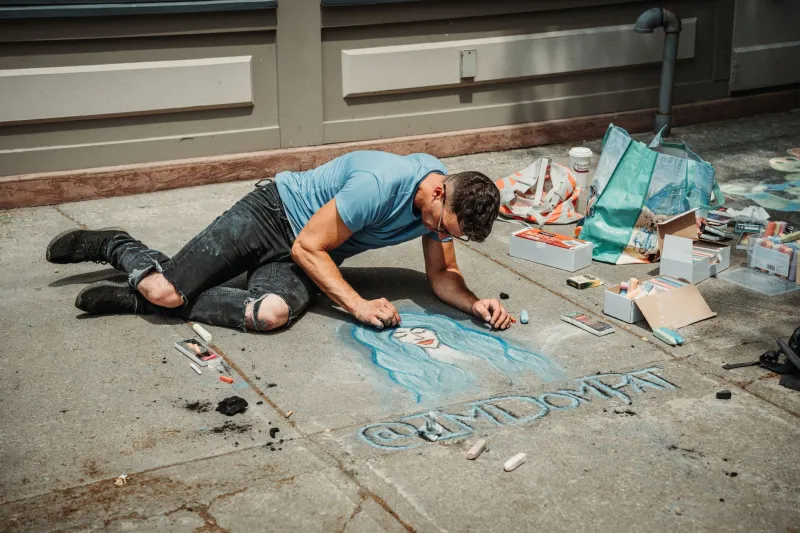
Somewhere in Portland, Oregon, on a Tuesday morning in late October, a woman named Delia Voss knelt on a rain-slicked sidewalk and drew the face of a hardware store that no longer exists. She worked from a photograph — the original building had been demolished in 2019 to make room for a parking structure — using soft chalk pastels and a jar of water to blend the edges. By Wednesday afternoon, the rain had taken it. By Thursday, you'd never have known it was there.
 Photo: Portland, Oregon, via bilder.fernsehserien.de
That's exactly how Delia wanted it.
"There's something about knowing it won't last that makes people actually stop," she says. "If it were a permanent mural, they'd walk past it every day until they stopped seeing it. This way, it matters right now."
Delia is part of a loose, mostly informal movement spreading across American cities and suburbs — artists who use sidewalk chalk, water-soluble paint, and temporary materials to tell stories rooted in specific places, specific losses, specific loves. They draw neighborhood histories. They write obituaries for demolished buildings. They leave love notes to vanishing diners, shuttered theaters, and corner stores that became condos. And they do it knowing the work has maybe forty-eight hours before foot traffic and weather erase it entirely.
The Art of the Immediate
The impulse isn't entirely new — street artists have been working in temporary mediums for decades — but something has shifted in recent years. Where earlier generations of sidewalk artists often aimed for spectacle (the trompe-l'œil pit in the pavement, the 3D dragon crawling out of the asphalt), this newer wave leans toward the intimate. The scale is smaller. The subject matter is hyper-local. And the audience is, almost by design, limited to whoever happens to walk past.
In Chicago's Pilsen neighborhood, a collective called Wet Pavement has been producing what they call "block elegies" since 2021 — chalk pieces that mourn specific buildings or businesses that have been lost to gentrification. One piece, installed outside a recently closed Mexican bakery on West 18th Street, reproduced the bakery's hand-lettered sign in three colors of chalk, surrounded by the names of families who'd bought their quinceañera cakes there for thirty years. The owner's daughter photographed it before it rained. She still has the photo as her phone background.
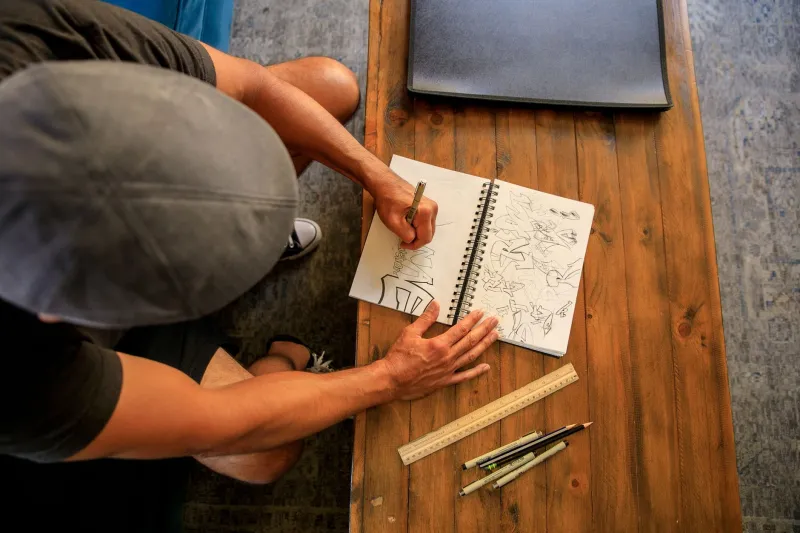
In Brooklyn, a former graphic designer named Marcus Osei spends weekend mornings drawing what he calls "pocket histories" — small, dense panels of text and illustration that tell the story of a single block. He sources his material from old newspaper archives, interviews with longtime residents, and city records. The work is meticulous. It takes him four to six hours to complete a single piece. He builds in no expectation of preservation.
"I'm not making something for the internet," Marcus says, though he acknowledges the internet has found him anyway. "I'm making something for the person who walks to the subway at 7 a.m. and needs a reason to slow down."
The Second Life Nobody Planned For
Here's the strange thing: the work is being preserved anyway.
Not by the artists themselves — most of them are deliberate about not archiving their own pieces — but by passersby, neighbors, and the occasional stranger who stumbles onto something extraordinary on their morning walk. Instagram accounts dedicated to documenting these fleeting works have popped up in cities from Seattle to Atlanta. There's a Reddit community with nearly forty thousand members where people post photographs of temporary street art they've encountered, often with no information about who made it or why.
One image from Denver — a chalk drawing of a woman in a 1940s dress standing in front of a building that's now a smoothie franchise — circulated widely enough last spring that local journalists tracked down the artist, a retired schoolteacher named Carolyn Marsh who had been drawing her grandmother's neighborhood from memory for three years, one block at a time, every Saturday morning.
"I was a little embarrassed when people started paying attention," Carolyn admits. "I wasn't doing it for that. I was doing it because I missed a place that doesn't exist anymore and I didn't know what else to do with that feeling."
The archiving creates an odd paradox at the heart of this whole movement. The artists make work that's born to disappear, and the community turns around and refuses to let it. The photograph becomes a kind of ghost — an image of an image of a memory, once removed from the original thing. Whether that counts as preservation or something else entirely depends on who you ask.
Witness as Participation
What the artists tend to agree on is that being there — in person, in the moment — is a fundamentally different experience than seeing a photograph of it later. There's something about standing on a sidewalk, looking down at a story drawn in chalk, knowing it won't survive the week, that changes how you receive it.
"Photographs flatten it," says Delia Voss. "When you're standing there, you're aware of the scale, the texture, the smell of the chalk. You're aware that someone was on their knees on this concrete for hours to make this thing that you're going to walk away from and never see again. That awareness is part of the piece."
Marcus Osei frames it differently. He talks about what he calls "the obligation of the witness" — the idea that if you happen to see something that exists briefly, you carry a small responsibility for it. "You were there. It happened to you. That's not nothing."
Some of these artists have started including QR codes at the edges of their work — not to document the piece, but to link to the source material. A chalk drawing of a demolished church might link to a 1967 newspaper article about its congregation. A portrait of a neighborhood elder who passed away might link to an oral history interview. The art becomes a doorway rather than a destination.
Why It Matters That It Goes Away
Permanence, it turns out, can be its own kind of erasure. Murals get painted over. Monuments get ignored. Plaques accumulate grime until no one reads them. The things we build to last have a way of becoming invisible through sheer familiarity.
There's a case to be made that a chalk drawing witnessed by two hundred people in a single morning, fully present and attentive because they know it won't be there tomorrow, does more cultural work than a bronze plaque that ten thousand people walk past without reading.
Delia Voss finished her hardware store portrait on a Tuesday and was gone before the first commuters came through. A woman named Sandra, who'd bought her first toolbox at that store in 1994, photographed it on her way to work and cried in her car for ten minutes. She posted the photo with a caption that said simply: Someone remembered.
By Wednesday evening, the rain had come through. The sidewalk was clean.
The photo has been shared four hundred times.
Both of those things are true, and maybe that's the point — that a story can vanish and still leave a mark, that the briefest things sometimes land the hardest, that art made to disappear has a funny way of sticking around.