Still Open: The Corner Stores That Know Every Secret Your Neighborhood Ever Had
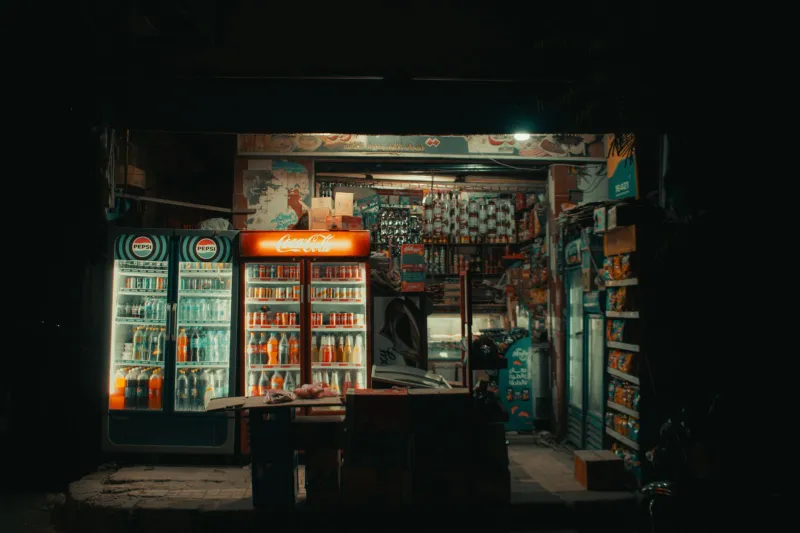
Walk into Ruiz Family Grocery on the east side of Cleveland and you'll notice, before you even grab a drink from the cooler, that the bulletin board by the door is so dense with paper it looks like a second wall. Birthday announcements layered over missing cat flyers layered over handwritten cards from kids who grew up shopping here and moved away years ago. Maria Ruiz, who has worked this counter since 1987, knows exactly what's on that board. Every single piece of it.
"People put things here because they know someone will see it," she says, smoothing the edge of a condolence card that's been pinned there for six months. "We still get foot traffic. Real foot traffic. People who live here."
That distinction — people who live here — is the quiet heartbeat of every surviving corner store in America. In an era of delivery apps and 24-hour chains, the ones still standing aren't competing on price or convenience. They're competing on something harder to quantify and impossible to replicate: memory.
More Than a Store
There's a particular kind of intimacy that only happens when you buy your groceries from the same person for thirty years. They know you took your coffee black until your second kid was born and then you switched to decaf. They remember when you were behind on rent and they let your tab ride for two weeks without saying a word about it. They were there when you came in red-eyed the morning after your mother died, and they handed you a bottle of water and didn't ask.
Those moments don't get recorded anywhere official. No oral history project captures them. No city archive files them away. But walk behind the counter of a long-running corner store and you'll find the evidence anyway — in shoeboxes of old layaway slips, in phone numbers written on the wall in marker from before anyone had a cell, in the photographs taped to the register showing regulars at quinceañeras and graduations and block parties that happened decades before you were born.
"This place is like a scrapbook that nobody planned," says DeShawn Patterson, who inherited Patterson's Market in Baltimore from his father, who inherited it from his father. The store opened in 1961. Three generations behind the same counter, watching the same streets change around them. "My grandfather used to say the store doesn't belong to us. It belongs to the block."
The Archive Nobody Asked For
What makes corner stores such unlikely repositories of neighborhood life is precisely that they never meant to be. Nobody sat down and decided to document anything. The receipts piled up because there was no time to throw them out. The photos stayed on the wall because taking them down felt wrong. The stories accumulated the way sediment does — slowly, without ceremony, one ordinary Tuesday at a time.
In Chicago's Pilsen neighborhood, a small grocery called La Paloma has a back room that its owner, Esperanza Delgado, describes as "a disaster" and everyone else describes as a miracle. There are handwritten recipes from customers who wanted her to stock specific ingredients. There are old school newsletters from the elementary school two blocks over. There are snapshots from every major snowstorm since 1994, because Esperanza's late husband thought it was funny to photograph the regulars shoveling out their cars and then put the pictures on the wall.
"People come back just to look at those photos," she says. "Grown men come in here and point at a little kid in a picture and say, 'That's me.' And I'm like — I know. I know it's you."
That recognition, that continuity, is something no chain store can manufacture. You can't train a rotating staff of part-time employees to hold thirty years of neighborhood history. It lives in the person, not the building.
What Gets Lost When the Lights Go Out
The math is brutal. According to data from the National Federation of Independent Business, small independent grocery and convenience stores have been closing at an accelerating rate for the past two decades, squeezed by rising commercial rents, supply chain disadvantages, and the relentless expansion of dollar stores and big-box retailers into urban neighborhoods.
When a corner store closes, what disappears isn't just a shopping option. It's a gathering point. A message board. An informal social safety net — because these are often the places that quietly extend credit to neighbors in hard times, stock specific cultural foods that chains don't carry, and serve as a first stop for anyone new to the block trying to figure out where they've landed.
"When we close, and I hope we don't, but when we close — what happens to all this?" Maria Ruiz gestures at the bulletin board, the photographs, the shoeboxes. She doesn't say it like a question. She says it like something she's already grieved.
Holding the Line
The corner stores that are surviving are doing so through a combination of community loyalty, creative adaptation, and something that doesn't show up on any balance sheet: sheer stubbornness. Some have added hot food counters or started stocking locally made products. Others have leaned into their identity as neighborhood institutions, hosting small events, partnering with local artists, becoming officially recognized as community landmarks.
In Brooklyn, a store that's been in the same family since the 1970s recently had its facade painted by a neighborhood muralist as part of a local arts initiative. The owner, an 80-year-old man named Frank who goes by Frankie to everyone, cried when he saw it. "I never thought about what this place looked like from the outside," he admitted. "I've only ever seen it from in here."
That's the thing about corner stores. The people running them are so deep inside the daily rhythm of the place that they often don't see what everyone else sees — which is a room that holds the neighborhood's whole life in it.
Still Scrolling
There's a reason people return to these places even when the prices are higher and the hours are shorter than the chain down the street. It's the same reason people keep old photographs, reread certain books, drive past houses they used to live in. We are wired to want evidence that our lives happened, that they mattered, that someone was paying attention.
Corner stores, the ones that are still standing, are paying attention. They always have been. Every receipt, every pinned flyer, every photo by the register is a page in a story that nobody planned to write but nobody can bear to throw away.
Ruiz Family Grocery is still open. So is Patterson's Market. So is La Paloma. For now, the lights are on and the door is unlocked and someone behind the counter knows your name.
That's worth more than any of us probably realize — until the day it isn't there anymore.