Your Name Was Here: The Century-Old Hotel Registries That Refuse to Forget Anyone
The pen is attached to the desk with a small chain. It's a cheap ballpoint, the kind that runs out faster than you'd expect, and the woman behind the counter replaces it about once a month. But the book it's chained to — that's a different story entirely.
At the Beaumont Inn in Harrodsburg, Kentucky, the guest registry stretches back over a hundred years. It's not a digital log, not a printed confirmation sheet, not a tablet asking you to sign with your finger. It's a physical book, thick as a dictionary, its spine worn soft from handling. And every name inside it was written by a human hand, in ink, by someone who had just arrived somewhere and wanted — maybe needed — the world to know it.
The Book Behind the Desk
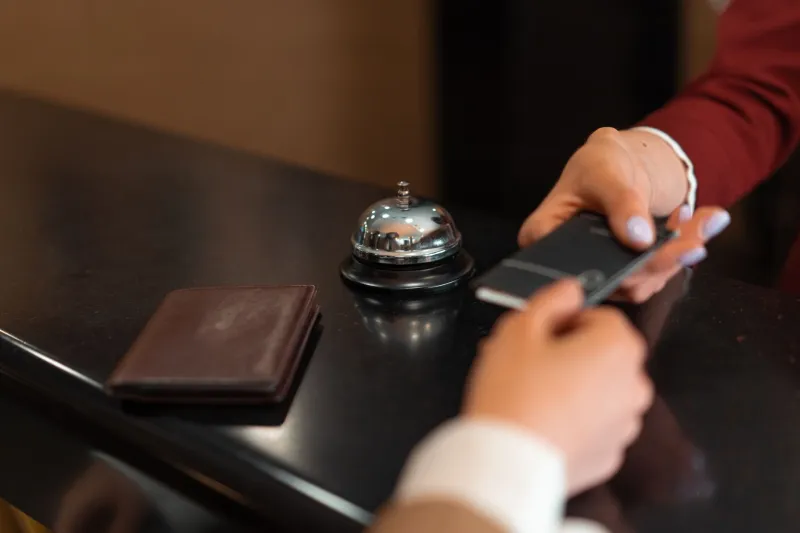
Most travelers don't think twice about check-in. You hand over a card, you get a key, you find the elevator. But at a small cluster of historic hotels scattered across the United States, the ritual goes a step further. The clerk slides a registry across the counter. You pick up the pen. You write your name.
It sounds almost absurdly simple. But ask anyone who's done it — really done it, with awareness — and they'll tell you it feels like something. Like signing into history. Like adding a single brushstroke to a painting that's been in progress for generations.
Margaret Hollis has worked the front desk at a historic inn in the Shenandoah Valley for going on twenty-two years. She's watched thousands of guests pause when the book comes out. "There's always this moment," she says. "They look at the page, they look at the pen, and then they look up at me like they're asking if it's real. And I always say, yes — it's real. Write your name."
She keeps the older volumes in a locked cabinet behind her. On slow afternoons, she takes one out and reads.
What Gets Left Behind
A guest registry is not a diary. It's not a comment card or a Yelp review. It's something stranger — a document that exists in the margins of intention. People aren't writing to be read. They're writing to mark a moment, the way you might scratch your initials into a wooden dock or tuck a note under a floorboard. I was here. This happened to me.
And because of that, what ends up in these books is wonderfully unguarded. A signature, sure. But also: the date of a honeymoon. A tiny sketch of a mountain drawn in the margin. A name written twice — once in a child's crooked block letters, once in an adult's practiced cursive — by the same person, thirty years apart.
That last image comes from a real entry at the Hotel Pattee in Perry, Iowa, a meticulously restored property that treats its own history like a living exhibition. Staff there have documented guests who first visited as children with their parents, then returned as adults with their own kids, then came back again as grandparents. Three generations of the same family, all in the same book, their handwriting aging across the pages like a slow-motion portrait.
"It's the most honest autobiography you'll ever read," says one longtime innkeeper at a Colorado mountain lodge that's been operating since the early 1900s. "No one's performing. They just write their name and move on. But when you look at it later, you see everything."
The Archivists Who Showed Up Accidentally
Nobody trains for this job. There's no degree in Guest Registry Preservation, no certification program for front desk historians. The people who take these books seriously — who catalog them, protect them from humidity, digitize the oldest pages — mostly stumbled into the role because they couldn't look away.
In Galveston, Texas, a hotel historian named Darnell Pruitt spent the better part of a decade cross-referencing a century-old registry with newspaper archives, census records, and old city directories. What he found surprised him. Traveling salesmen, jazz musicians passing through on tour, families displaced by storms, a pair of names that appear side by side for the first time in 1931 and then together every single year after that until 1974. "You start to see the patterns," he says. "The people who kept coming back. The people who only came once. And you start to wonder about both."
He's not a professional archivist. He's a guy who got a part-time job at a hotel in his thirties and got obsessed with a cabinet full of old books. That's how most of these preservation stories start.
The Return Visit
Perhaps the most quietly moving thing about these registries is the return. Guests who signed a book twenty or thirty years ago — sometimes more — come back specifically to find their own entry. They flip through the pages slowly, holding their breath a little, until they land on it. Their name, in their own younger handwriting, on a day that mattered.
Some bring their children to show them. Some take a photograph of the page and don't say much. Some cry, which nobody in the lobby comments on, because everybody understands.
At a historic inn in the White Mountains of New Hampshire, a woman came back two years ago to find the entry she'd made on the night of her first anniversary. Her husband had died the previous spring. She found the page, ran her finger across his signature, and sat in one of the lobby chairs for a long time. The front desk clerk — a young man, early twenties, first year on the job — didn't know what to say. So he didn't say anything. He just let her sit.
"That's when I understood what the book actually was," he said later. "It's not a record. It's a place people come back to."
Why the Pen Still Matters
In an era of contactless check-in and app-based room keys, the handwritten registry is an almost radical act. It's slow. It's inefficient. It requires a pen that will inevitably run dry and a book that will eventually fill up and need to be stored somewhere safe.
And yet the hotels that keep them aren't doing it out of nostalgia alone. They're doing it because guests respond to it — because something about writing your name by hand in a shared book does something that a digital timestamp simply can't replicate. It puts you in a line. It connects you, physically and literally, to everyone who held that pen before you.
There's a word for what these registries are, if you want to get philosophical about it. They're a scroll. A long, continuous record of human presence, unspooling across years and decades, one name at a time. No algorithm curates it. No feed filters it. It's just people, arriving somewhere, and leaving a mark that says: I came here. I was real. I was part of this.
That's a small thing. It's also everything.