36 Frames and Counting: The Young Photographers Choosing Film to Make Every Shot Mean Something
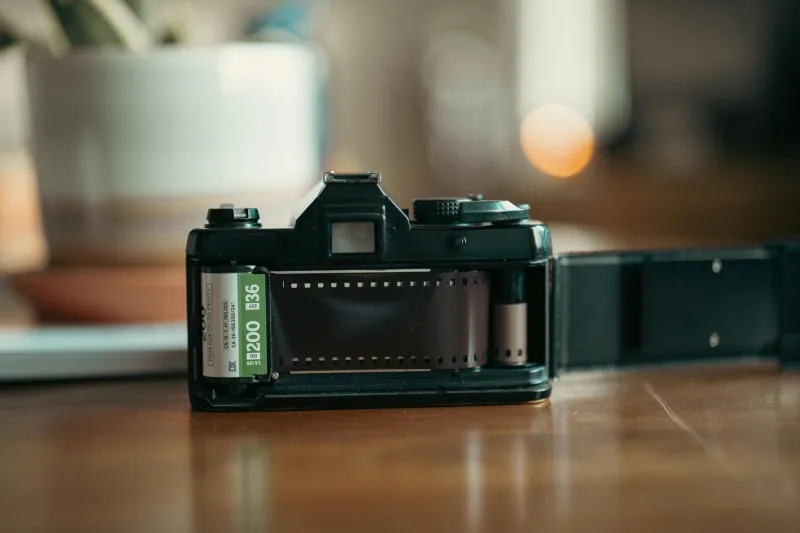
Maya Okonkwo was standing in her grandmother's kitchen in Memphis when she made the decision. She'd just scrolled through her phone camera roll — 4,200 photos from the past eight months — and couldn't name a single one she actually cared about. "I had documented everything and remembered nothing," she says. "It felt like I'd been eating a lot but never tasting anything."
A week later, she found a Canon AE-1 at an estate sale in Midtown for twelve dollars. She loaded a roll of Kodak ColorPlus, took it home, and didn't touch it for three days because she was nervous about wasting a frame.
That nervousness, she'll tell you now, was the whole point.
The Weight of a Finite Roll
Across the country, in apartments and darkrooms and community photo labs from Portland to Pittsburgh, a loose, largely self-taught community of film shooters is making the same choice Maya made. They're not all in their twenties, and they're not all chasing an aesthetic. What connects them is something harder to Instagram: the deliberate embrace of constraint.
Film rolls are finite. A standard 35mm roll gives you 24 or 36 exposures. There's no burst mode. No instant review. You shoot, you wind, you move on — and then you wait, sometimes days, sometimes weeks, before you see what you actually captured. For a generation raised on instant feedback and infinite storage, that wait feels almost countercultural.
"The uncertainty is the feature, not the bug," says Dominic Reyes, a 27-year-old graphic designer in Chicago who shoots almost exclusively on a battered Minolta he bought off eBay for $30. "When I'm shooting digital, I'm always half-checking the screen, second-guessing myself. With film, I have to commit. I have to actually look at what's in front of me."
Dominic runs a small online forum where film shooters swap developing tips, recommend labs, and post about tracking down expired rolls at flea markets and estate sales. The community has grown quietly but steadily — no brand deals, no sponsored posts, just people who want to talk about f-stops and developer ratios at 11 p.m. on a Tuesday.
The Hunt for the Perfect Roll
Part of what makes film culture feel alive right now is the scavenging. Expired film — rolls that have sat in someone's closet or camera bag for years past their sell-by date — has its own devoted following. The colors shift, the grain gets unpredictable, and highlights blow out in ways that no filter can authentically replicate. For a lot of shooters, that unpredictability is exactly what they're after.
Sadie Fuentes, a 24-year-old in Austin, has become something of a minor legend in her local film community for her expired film hauls. She hits estate sales every weekend, specifically looking for cameras that still have half-finished rolls inside. "You find a camera in someone's attic and there are still frames left on the roll," she says. "I'll finish the roll and develop it, and suddenly I'm sharing a roll of film with a stranger from twenty years ago. That's wild to me."
Sadie develops most of her film at home in her bathroom using a daylight tank and chemistry she orders online. She's gotten her process down to about an hour from start to dry, and she documents each step in a small journal — not for content, she's quick to clarify, but because she wants to remember what she learned.
"There's this whole thing people say about how digital is free so you can shoot without thinking," she says. "But I don't think free is always good. Paying attention to something costs you something. That cost is the point."
Slowing the Moment Down
The psychology behind all of this is worth sitting with. There's a growing body of research suggesting that the act of photographing something can actually impair memory of it — that clicking a shutter can become a substitute for real attention rather than an extension of it. Film photographers talk about this constantly, even if they don't always cite the studies.
What they describe instead is a shift in how they experience the moments they photograph. When you know you have twelve frames left and you're at a family reunion in North Carolina and the light is doing something strange through the porch screens, you don't just fire away. You watch. You wait. You decide.
"I remember every photo I've taken on film," says Marcus Webb, a 31-year-old teacher in Philadelphia who started shooting on a Nikon FM2 he inherited from his father. "I can tell you what I was thinking, what the air smelled like, what happened right after. With my phone, I couldn't tell you anything about most of those 4,000 pictures."
Marcus teaches high school English, and he's started bringing his camera into the classroom — not to photograph students, but to talk about storytelling. He uses the idea of finite frames as a metaphor for narrative choice. What do you include? What do you leave out? What are you willing to commit to without knowing how it'll look in the end?
"Film is basically a writing lesson," he says, laughing. "You can't revise a frame after you've taken it."
The Lab, the Wait, the Reveal
For those who don't develop at home, the local photo lab has become a kind of community anchor. Places like Citizens Photo in Portland, Indie Film Lab in Alabama, and The Darkroom in California have seen steady upticks in mail-in orders from younger customers. The wait — usually a week or two for mail-in labs — is something shooters talk about with a kind of reverence.
"I dropped off a roll from a camping trip in Utah and then went two weeks without thinking about it," says Maya, now two years into her film practice. "When the scans came back, it was like getting a letter from my past self. I'd forgotten half of what I shot. The photos remembered things I didn't."
That's the thing about film that keeps coming up in every conversation. It doesn't just capture a moment — it holds it at arm's length until you're ready. The delay creates distance, and distance creates perspective. You're not looking at what you shot five seconds ago. You're looking at who you were two weeks ago, standing somewhere that mattered, paying enough attention to press the shutter.
In a world where every image is instant and infinite, there's something quietly radical about choosing to wait. About choosing to not know. About rolling the film forward and trusting that you saw something worth keeping — before you have any proof that you did.
Maya still has that Canon AE-1. She's shot 22 rolls on it. She keeps them all in a shoebox under her bed, labeled by month and place. "It's not an archive," she says. "It's more like a diary. Except I didn't write it. I just looked."