Rewind, Repair, Repeat: The Americans Keeping Dead Technology Breathing
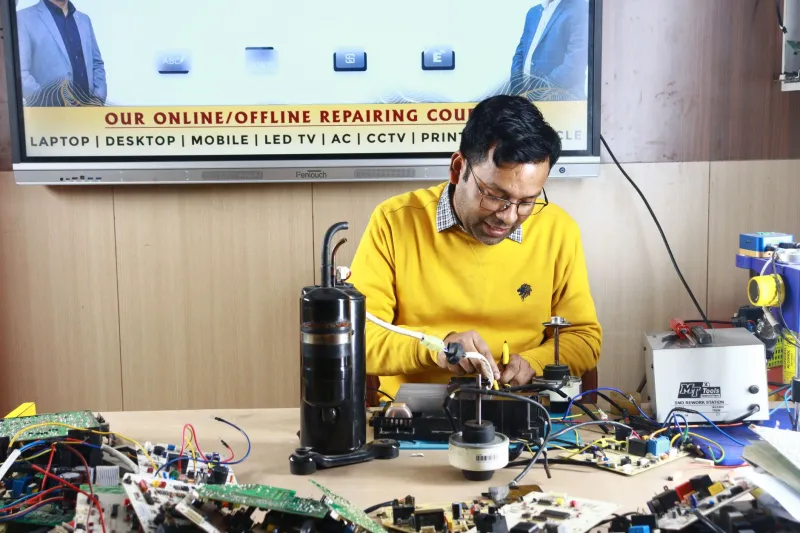
The sign on Gerald Hutchins's shop window says Hutchins Electronics — Est. 1988 in stick-on letters, a few of which have started to peel. Inside, the shelves are a geological record of American consumer technology: boom boxes, reel-to-reel tape decks, projection televisions the size of small furniture, and, stacked in careful towers along the back wall, VCRs. Dozens of them. Some waiting to be repaired. Some already fixed and waiting to go home. A few that Gerald is keeping because nobody came back for them and he couldn't bring himself to throw them away.
"People think this is a dying business," he says, not looking up from the machine he's currently working on. "But I've got a six-week backlog."
Gerald is 67. He learned to repair electronics from his father in a garage in Cincinnati. He has no plans to retire. And in a country that upgrades its devices roughly every eighteen months and treats last year's technology as functionally antique, he has become, without quite intending to, a kind of cultural custodian.
The Things We Were Supposed to Throw Away
The official story of technological progress runs in one direction: newer is better, older is obsolete, and anything that can't connect to Wi-Fi is already halfway to the landfill. It's a story that serves the people selling you next year's model. It doesn't hold up particularly well when you actually talk to the people living outside it.
VCRs stopped being manufactured in 2016. Blockbuster closed its last corporate store in 2013 (one franchise location in Bend, Oregon, remains open and has become something of a pilgrimage site). Super 8 film, the format that documented millions of American childhoods before the camcorder arrived, was briefly discontinued by Kodak and then brought back due to sustained demand. Cassette tapes, declared dead so many times the announcements have become almost ceremonial, now outsell CDs in certain markets.
None of this was supposed to happen. And yet.
"The narrative is always that people are just being nostalgic," says Dr. Ramona Vásquez, a media studies professor at the University of Texas at Austin who researches obsolete technology communities. "But when you actually spend time with these people, nostalgia is almost never the primary thing. It's more complicated than that."
Presence, Patience, and the Weight of a Tape
Ask anyone who still shoots on Super 8 why they do it, and you'll get some version of the same answer: because it makes them slow down.
Katelyn Briggs is 29. She lives in Portland, Oregon, and works as a video editor—meaning she spends her professional life in the most efficient, high-resolution, instantly-reviewable digital workflow available. On weekends, she loads a cartridge of Super 8 film into a camera that belonged to her uncle and shoots about three minutes of footage that she won't see for two weeks, after she mails the cartridge to a lab in California for processing.
"Every single frame costs money and time," she says. "So you think about what you're pointing the camera at. You think about whether this moment is worth it. And that changes what you make and how you feel about what you made."
This is the thing that gets lost in the nostalgia framing: the appeal isn't primarily about the past. It's about a specific kind of relationship with the present. Obsolete media formats, almost by definition, resist the instant gratification loop. You can't immediately share a Super 8 frame on Instagram. You can't skip ahead on a VHS tape without watching the counter slowly tick. You can't accidentally delete a roll of film with a wrong swipe.
The friction is the feature.
Gerald's Waiting Room
Back in Dayton, Gerald's customers are a cross-section that surprises people who assume this is purely a retiree phenomenon. Yes, there are older customers who want to watch tapes they've had since the 1980s. But there are also a striking number of people in their 20s and 30s, often carrying tapes they found in a parent's closet or a thrift store bin.
"Young people come in with a tape and they don't even know what's on it," Gerald says. "Could be a family Christmas. Could be a kid's birthday. Could be nothing. But they want to find out. They want to see it the way it was meant to be seen."
That last phrase—the way it was meant to be seen—carries more weight than it might initially seem. There's a whole conversation happening among archivists and film preservationists about whether digitized media is really the same thing as preserved media, or whether something essential changes when you pull content out of its original format. The people in Gerald's waiting room aren't necessarily following that academic debate, but they're arriving at a similar instinct: the container is part of the experience.
Repair as Resistance
There's a political dimension to all of this that practitioners don't always articulate explicitly but that runs just beneath the surface. Keeping old technology alive is, among other things, an act of resistance against disposability culture—the relentless economic pressure to replace rather than repair, to upgrade rather than maintain, to treat objects as temporary rather than durable.
Right to Repair legislation has been gaining traction in several states, pushing back against manufacturers who design products to be unrepairable. The community of people fixing VCRs and reel-to-reel decks and Super 8 cameras is, in its own grassroots way, making the same argument: things that work should be allowed to keep working.
Marcus Webb, a 34-year-old who repairs vintage audio equipment out of a shared workshop space in Brooklyn, puts it plainly: "Every time I fix something instead of replacing it, I'm saying that this object has value beyond its market value. That's actually kind of a radical position right now."
The Tape at the End of the Shelf
Before leaving Gerald's shop, I ask about the VCRs along the back wall—the ones nobody came back for. He shrugs.
"Some people drop stuff off and you never hear from them again. Life happens. People move. Sometimes they pass away and the family doesn't know to come."
He picks up one of the unclaimed machines and turns it over in his hands. It's a Panasonic, mid-90s model, in good condition. He repaired it months ago.
"I keep them because someone cared enough to bring it in," he says. "That means something. You don't just throw that away."
He sets it back on the shelf, carefully, and goes back to work.