Pull Up a Chair: The Film Festivals Turning Barns, Backyards, and Broken-Down Theaters Into Sacred Screens
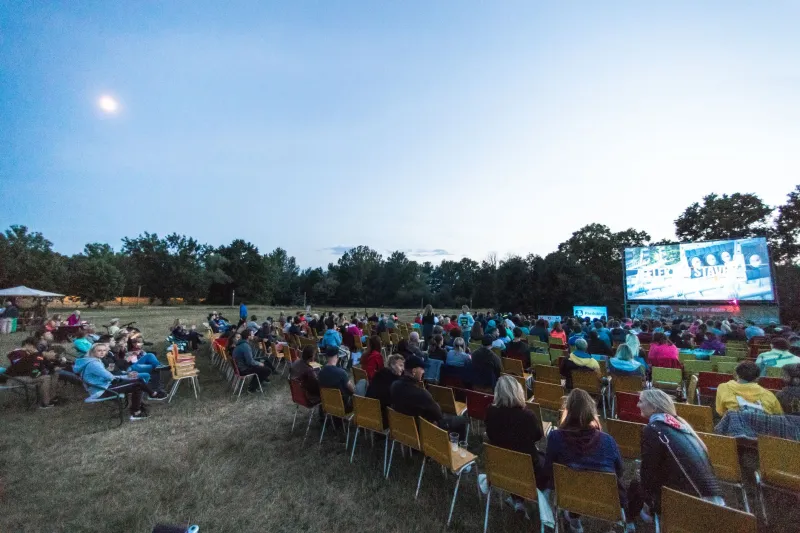
The movie starts at dusk in a field outside of Marfa, Texas, because that's when the light finally cooperates. Folding chairs, lawn chairs, a few blankets spread on the dry grass. Someone brought a cooler. Someone else brought their dog. The projector — a real projector, not a laptop hooked to a bedsheet — throws a rectangle of light against a screen that was hand-sewn by the festival's co-founder the previous spring.
The film is a 1973 documentary about a woman who spent forty years cataloging birdsong in the Chihuahuan Desert. Nobody in the audience has heard of it. By the time it ends, three people are crying softly and everyone wants to talk.
That's the whole idea.
The Programmers Who Think About Cinema Differently
Across the United States, a loose network of independent film programmers is doing something that runs counter to the entire trajectory of modern entertainment: they are making watching movies harder to do alone. Not by removing convenience, exactly, but by creating contexts so specific, so carefully considered, so placed, that the experience can't be replicated on a couch.
These aren't Sundance. They don't have acquisition deals or publicists or late-night parties with recognizable faces. What they have is a vision of cinema as a communal act — something that requires bodies in the same space, breathing the same air, responding to the same image at the same time.
Reed Calloway runs a one-weekend festival out of a converted dairy barn in the hill country of central Tennessee. He started it seven years ago with a borrowed projector and a mailing list of forty people. Last year, nearly three hundred people attended across two days, sleeping in tents on the surrounding property, cooking communal meals, and watching films that ranged from a 1960s Taiwanese melodrama to a locally made short about a family of mushroom foragers.
"I don't program for taste," Reed says, sitting on a hay bale at the edge of the empty barn, afternoon light cutting through the slats. "I program for conversation. I want people to walk out of that barn and not be able to stop talking."
The Spaces That Change What You See
One of the more compelling arguments these festivals make — implicitly, through their choices — is that the space where you watch a film is not neutral. A parking lot in Detroit, a rooftop in New Orleans, an abandoned grain elevator in rural Kansas: these settings don't just host the film. They become part of it.
In Chicago's Pilsen neighborhood, a collective called Cine Vecino (they describe themselves as "a film club that got out of hand") has been programming outdoor screenings in alleyways, community garden plots, and the parking lots of churches for the past four years. They show films in Spanish, in English, in both. They show Mexican cinema alongside American independent films from the 1970s alongside brand-new shorts by filmmakers from their own neighborhood.
"The alley matters," says co-organizer Daniela Ruiz, who grew up in Pilsen. "When you watch a film about displacement in a neighborhood that knows about displacement, it hits different. The space is doing work."
She pauses, then adds: "Also, someone always brings tamales. That helps."
The Curation as Storytelling
What separates these festivals from, say, a movie night in someone's backyard is the intentionality of the programming. The curators think hard — sometimes obsessively — about sequence, pairing, and context. Which film opens the evening? What conversation does it start? What film follows it and either deepens or complicates that conversation?
In this sense, the programmers are themselves storytellers. The individual films are chapters. The festival is the book.
In upstate New York, a former film studies professor named Theo Abramowitz runs a two-day event he calls "The Wrong Program" — a deliberately provocative title for a festival where no two films in a block share a genre, language, or era. The point is to destabilize habits. To make audiences uncomfortable with their own preferences.
"People come in thinking they like certain things," Theo says. "I want to find the edges of that. I want to show them a 1948 Italian neorealist film right before a 2019 short by a twenty-two-year-old from Phoenix and watch what happens when those two things sit next to each other."
What happens, apparently, is that people talk for hours afterward. Last year's festival ended with an impromptu group discussion that went past midnight in a parking lot lit by string lights.
"Nobody wanted to go home," Theo says. "That's how you know it worked."
The Economics of Not Caring About the Economics
None of these festivals are profitable in any conventional sense. Most operate on small grants, community donations, and the labor of people who have other jobs. Tickets — where they're charged at all — are priced at whatever the community can bear, often on a sliding scale. Reed in Tennessee charges what he calls "the price of a decent meal" for the whole weekend, camping included.
"If we were trying to make money, we'd be doing something else," he says simply.
What they are making, they'd argue, is something harder to quantify. Community. Shared reference points. The particular kind of friendship that forms when you've sat in the dark together and felt the same thing.
Daniela in Pilsen talks about a woman in her sixties who came to her first Cine Vecino screening alone and has been to every one since. She brings her grandchildren now. She's brought her neighbor. She once brought her dentist.
"She told me she didn't used to think movies were for her," Daniela says. "Now she thinks cinema is the most important thing there is. I don't think that would have happened if she'd just watched something on her phone."
The Part That Streaming Can't Copy
There's a moment that every one of these festival organizers describes in slightly different language but with the same essential shape: the moment when the film ends and the lights come up — or the stars come out, or the barn goes quiet — and the audience doesn't immediately reach for their phones. They turn to each other instead.
That moment, small and ordinary as it sounds, is what all of this is actually for.
A field in Marfa. A barn in Tennessee. An alley in Pilsen. A parking lot in upstate New York. Pull up a chair. The movie's about to start, and you're going to want to talk about it after.