Red Light, Slow Hands: The DIY Darkroom Builders Making Sacred Spaces Out of Spare Closets
The first thing Marcus Webb did when he moved into his Portland bungalow was measure the coat closet. Not for storage. Not for shelving. He stood there with a tape measure and a notebook, already doing math in his head — how many feet of blackout curtain, whether the ventilation would be enough, where exactly he'd run the water line.
Six weeks later, he had a darkroom.
"People think I'm being precious about it," he says, laughing a little. "And maybe I am. But when I close that door and the red light comes on, it's the only place in my life where nothing else can reach me."
Marcus is part of a quiet but surprisingly active community of amateur darkroom builders scattered across the country — people who are voluntarily choosing the slow, chemical-soaked, light-sensitive process of analog photography development over the instant gratification of a phone camera and a filter. They're converting coat closets in Chicago apartments, utility rooms in suburban Phoenix homes, spare bathrooms in Nashville bungalows. One guy in Tucson built his in a converted cargo trailer. A woman in Burlington, Vermont does all her printing in what used to be a mudroom off the kitchen.
None of them are doing it because it's easier. That's almost entirely the point.
Why Now
It would be easy to write this off as nostalgia — a reaction against screens, a Gen X thing, a hipster affectation. But spend any time talking to these people and a more complicated picture develops. Pun intended, and they'd probably groan at it.
Many of them came to darkroom work through film photography, which has seen a genuine resurgence over the past decade. Film camera sales have climbed steadily. Kodak brought back Ektachrome. Labs that process film are backlogged in cities like Los Angeles and Brooklyn. But sending your rolls to a lab, for a lot of these folks, started to feel like handing your journal to someone else to read and then summarize for you.
"I wanted the whole thing," says Priya Desai, who turned the second bathroom of her Atlanta townhouse into a working darkroom about two years ago. "Shooting the frame is just the beginning. The developing, the printing — that's where you actually understand what you made."
Priya works in UX design during the day, a job built around optimizing for speed and reducing friction. The darkroom is the deliberate opposite. There are steps you cannot skip. There are temperatures that matter. There is a specific sequence to everything, and if you rush it, you ruin it.
"I think that's what I needed," she says. "Something I genuinely cannot rush."
The Build
Building a home darkroom is not a weekend project, exactly, but it's more achievable than most people assume. The basics: a room you can make completely dark, running water nearby (or a workaround), a few trays, an enlarger, chemistry, and enough ventilation to keep the fumes from becoming a problem.
Online communities — Reddit threads, Discord servers, Facebook groups with names like "Darkroom Builders USA" — have become indispensable resources. People post their builds in progress, troubleshoot light leaks with strangers in Ohio, debate the merits of different safelight setups. There's a generosity to it, a kind of collective problem-solving that feels refreshingly analog even when it happens online.
Jordan Kessler, who built his darkroom in a windowless basement room in his Milwaukee home, spent three months lurking those forums before he bought a single piece of equipment. "I probably read every build thread from the last five years," he says. "By the time I started, I'd already made every mistake in my head."
His setup now is modest but fully functional: a secondhand Omega enlarger he found on eBay for $80, a set of Paterson trays, a temperature-controlled water bath he rigged from a sous vide cooker and a plastic tub. Total investment, he estimates, was under $400. "People think it costs a fortune. It doesn't have to."
The Ritual
What these builders talk about most, though, isn't the equipment or the chemistry. It's the ritual.
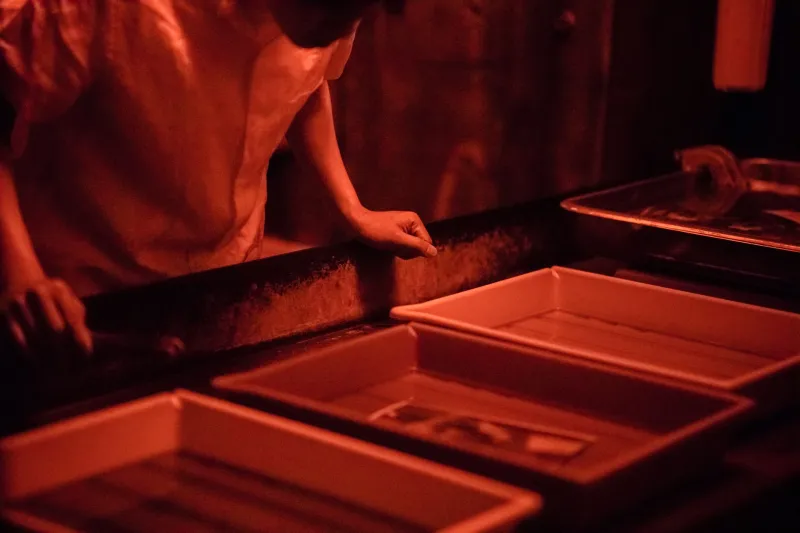
There's a sequence to entering a darkroom that feels almost ceremonial. You check the door seal. You wait for your eyes to adjust. You mix your chemicals — developer, stop bath, fixer — in a specific order, at specific temperatures. And then, when you finally slide an exposed piece of photo paper beneath the enlarger and flip the light on for a counted number of seconds, you're committed. Whatever happens in that tray is what happens.
The moment the image begins to appear — ghosting up through the developer, slowly resolving from nothing into something — is described by nearly everyone the same way: magic. Even people who've done it hundreds of times still use that word.
"You never get used to it," says Webb. "Every single time, there's this moment where you're like — there it is. That's the thing I saw. That's the light that was actually there."
It's a fundamentally different relationship with an image than anything digital allows. The photograph that comes out of a darkroom carries the physical evidence of its own making. It's been touched by light, by chemistry, by your hands. It has a material history.
Slowness as Practice
Some of the people building these spaces talk about it in almost therapeutic terms. Not as a replacement for actual therapy, but as a kind of structured mindfulness that doesn't require you to sit still and breathe — it requires you to do something, carefully, with your hands.
"I have anxiety," says Desai, matter-of-factly. "And there's something about the darkroom that quiets it in a way that meditation never really did for me. You can't be anxious about your email when you're watching a print come up. You're just there."
Kessler describes it differently but arrives at a similar place. "It's the only time I'm not multitasking. I can't be. The process won't let me."
In a cultural moment saturated with content, with images produced and discarded at a rate no one can keep up with, there's something genuinely countercultural about spending three hours to make one print. About building a room in your home specifically designed to slow you down.
A Space That Means Something
That's really what these darkrooms are, at their core. Not photography labs. Not hobbyist studios. They're spaces built with intention, dedicated to a process that demands your full presence in exchange for something you made with your own hands.
Marcus Webb prints maybe a dozen images a year that he considers finished. He frames a few, gives some away, keeps the rest in a flat file he bought from a closing print shop. He shoots a lot more than that — rolls and rolls — but the printing is selective. Deliberate.
"Every print means something," he says. "Because it cost me something. Time. Attention. You can't just swipe past it."
He pauses, looking at the closet door at the end of the hallway. Blacked-out. Sealed. Waiting.
"That room is the most honest space in my house," he says. "Everything in there is real."