Frozen in Time: The Analog Photographers Stockpiling Discontinued Film Like It's the End of the World
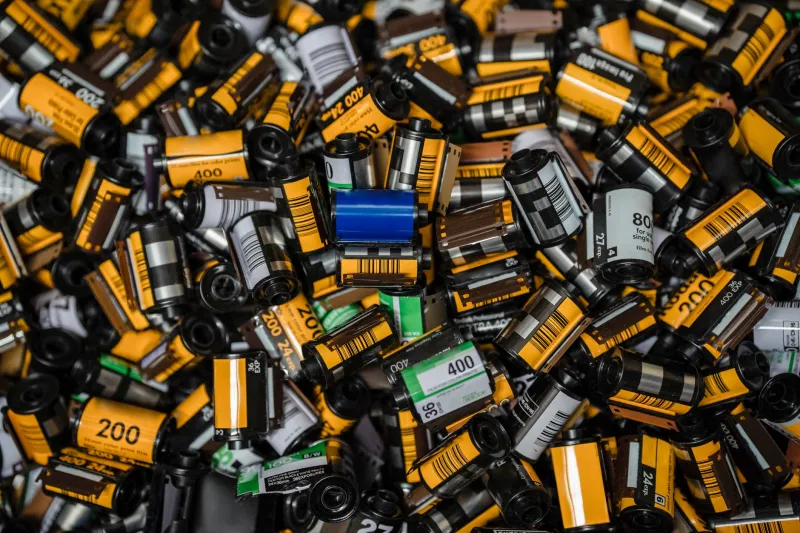
Marcus Webb's garage in Albuquerque doesn't look like much from the outside. There's a workbench, some old shelving, a few bikes nobody rides anymore. But open the chest freezer in the corner and you'll find something he guards more carefully than most people guard their savings: 287 rolls of Kodak Ektachrome 64T, a tungsten-balanced slide film discontinued in 2012. Each roll is vacuum-sealed, labeled, and organized by expiration date. He knows exactly what he has. He's been adding to it for over a decade.
"People think I'm nuts," he says, laughing a little. "But when that film is gone, it's gone. Nobody's bringing it back. So yeah, I'm a little nuts."
Marcus is part of a loose, passionate, and surprisingly organized community of analog photographers who've turned discontinued film stock into something close to a sacred resource. They trade on private forums, haunt eBay at odd hours, and maintain meticulous freezer inventories that rival any archival operation. For them, the question isn't whether to stockpile—it's how much is enough.
The Grief Behind the Hoarding
Every photographer in this world has a story about the one that got away. For some it's Fuji Velvia 50, a slide film beloved for its almost hallucinatory color saturation. For others it's Agfa Ultra 50, or Kodachrome—always Kodachrome—the film that Paul Simon wrote a song about and that Kodak killed in 2009 after 74 years of production. The last roll was developed at Dwayne's Photo in Parsons, Kansas, and the moment was covered by news outlets as if a minor cultural figure had died.
In a way, something had.
Film stocks aren't just light-sensitive chemicals. They're aesthetic vocabularies. Each emulsion has its own color rendition, its own grain structure, its own way of handling shadows and highlights. Photographers spend years, sometimes careers, learning to see through a particular stock. When it disappears, they don't just lose a tool—they lose a language.
"It's like if someone told you they were discontinuing a specific shade of blue," says Priya Anand, a portrait photographer based in Portland, Oregon, who keeps a dedicated mini-fridge stocked with her remaining supply of Fuji Neopan 1600, a black-and-white film that Fuji quietly killed off in 2013. "You can approximate it. You can find something close. But it's never the same thing."
The Underground Economy
The market for discontinued film is real, chaotic, and occasionally breathtaking in its prices. A single roll of Kodachrome 64 in good condition—even knowing it can no longer be processed anywhere on earth—can fetch upward of $80 on eBay. Rolls of Fuji FP-100C, a peel-apart instant film discontinued in 2016, regularly sell for $30 to $50 each. The more obscure the stock, the more fanatical the pursuit.
There are forums dedicated entirely to these trades. Discord servers where members post freezer hauls like trophy photos. Reddit threads where someone in Ohio will ship a roll of 1980s Soviet Svema film to someone in California for the price of postage plus a handshake agreement of karmic goodwill. It's a gift economy and a marketplace at the same time, governed less by profit than by a shared conviction that these materials matter.
"I've traded film for film, film for darkroom equipment, film for a really good bottle of whiskey once," says Derek Okafor, a Chicago-based street photographer who moderates one of the larger private trading communities. "It's not really about money. It's about making sure the right people have it and actually use it."
Derek maintains what he calls his "working stock" separately from his "archive stock"—the rolls he shoots versus the rolls he's preserving. Some of his archive stock he may never shoot. He knows this. He's made peace with it, mostly.
The Chemists in the Basement
Not everyone is content to simply preserve what's left. A small, technically ambitious corner of the community is trying to do something more audacious: bring discontinued stocks back from the dead.
The chemistry of photographic emulsions is complicated but not impenetrable, and a handful of hobbyist chemists have been quietly working to reverse-engineer lost formulas. The Film Photography Project, a community-driven effort with roots in the early 2010s, has documented some of this work. Independent labs like Film Ferrania in Italy successfully crowdfunded a revival of their own P30 black-and-white film. CineStill, a California company, built a business around repurposing Kodak motion picture film for still cameras.
These aren't full resurrections—they're translations, interpretations, educated guesses layered over institutional memory. But they matter.
"You can get surprisingly close," says one hobbyist chemist in Austin who asked to be identified only as "Emulsion Guy" online, as he still works a day job in an unrelated field. He's been experimenting with hand-coating film for three years and has shared his notes freely with the community. "The hard part isn't the chemistry. The hard part is the consistency. The big manufacturers had machines that could coat film to tolerances most home setups can't match. But you can make something beautiful. Just not identical."
What Are They Really Saving?
Ask any of these collectors what they're actually preserving and the answers get philosophical fast.
Marcus in Albuquerque says he's saving a way of seeing. Priya in Portland says she's saving a feeling—the specific anxiety and attention that comes from knowing you have 36 frames and no undo button. Derek in Chicago says he's saving proof that some things are worth the inconvenience.
There's something else underneath all of it, though. Something about permanence and loss and the particular way humans respond when they sense that something irreplaceable is slipping away. The freezers full of film, the frantic eBay searches, the underground trades—they're not just about photography. They're about the refusal to let go of things that made the world look a certain way.
Kodachrome is gone. Nothing will bring it back. But in garages and basements and dedicated mini-fridges across the country, people are doing their best to make sure the conversation doesn't end just because the manufacturer walked away from the table.
Marcus closes the freezer lid carefully. He's got a shoot this weekend—portraits of his sister's family, their first in years. He's going to use six rolls of the 64T.
Only 281 left after that. For now, that feels like enough.