Coffee, Pie, and the Truth: Inside the Diners Where America's Best Stories Are Told
Coffee, Pie, and the Truth: Inside the Diners Where America's Best Stories Are Told
Let's get something straight before we start: the best storytelling in America right now is not happening on a stage. It's not happening in a podcast studio or a writers' room or a TED conference. It's happening at the counter, at 2 a.m., over coffee that's been on the burner too long, between people who didn't plan to say anything worth remembering.
It's happening in diners.
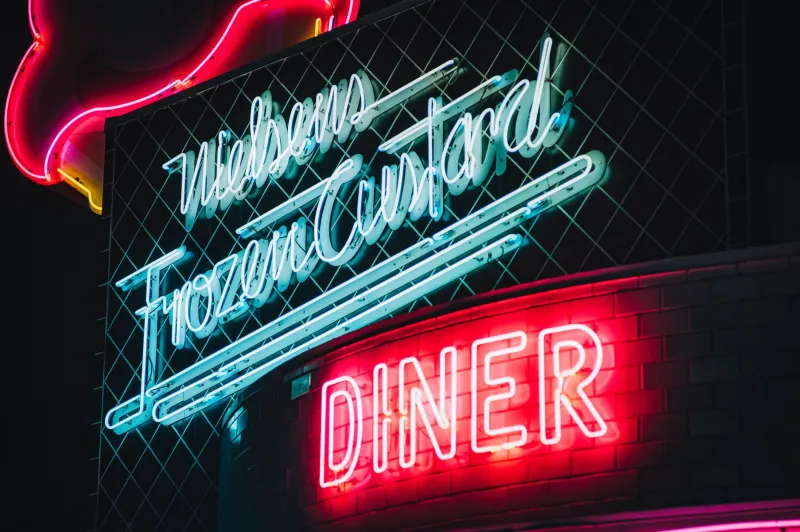
Not as a metaphor. Literally, in diners — those stubborn, beautiful, slightly-sticky American institutions that have somehow survived fast food and food delivery apps and the general cultural pressure to eat quickly and alone. The diner endures because it provides something no app has cracked: a reason to sit still with strangers and talk.
I visited three of them. Here's what I found.
The Truck Stop Oracle: Outside Wells, Nevada
The Silver Sage is easy to miss if you're driving fast, which most people on Route 93 are. It's a low, neon-signed building attached to a gas station in the high desert east of Wells, Nevada, and it smells exactly like you'd want it to — coffee and bacon and something indefinably American.
 Photo: Wells, Nevada, via topclassactions.com
The overnight cook is a sixty-one-year-old named Ray Thibodeau who has worked the 10 p.m. to 6 a.m. shift at the Silver Sage for fourteen years. He is, by any reasonable measure, one of the best storytellers I've ever encountered, and he has never told a story into a microphone.
"People get honest at 3 a.m.," Ray said, flipping eggs without looking at them. "They've been driving for eight hours. They're tired. They don't have the energy to be whatever they're trying to be everywhere else. So they just... talk."
On the night I sat at his counter, Ray served a long-haul trucker named Dennis who was hauling refrigerated pharmaceuticals to Boise and hadn't slept more than five hours in two days. Dennis ate a patty melt and told Ray about his daughter's college graduation, which he'd missed for a delivery that paid double. He wasn't complaining, exactly. He was just saying it out loud, maybe for the first time.
Ray listened. He refilled the coffee. He said, when Dennis was done: "You'll make it up to her. That's what dads do."
Dennis nodded, paid his bill, and walked back out into the Nevada dark.
"He'll be okay," Ray said, watching the truck pull out. "He just needed somebody to hear it."
That's the diner's first function, and maybe its most important one: it is a place where things get said out loud.
The Brooklyn Counter: Flatbush, New York
Vera's Luncheonette on Flatbush Avenue has been open since 1967, which means it has outlasted five presidents, three recessions, and the complete transformation of the neighborhood around it. The current owner, a woman named Claudette Morrow who inherited the place from her aunt, makes no claims to being a historian. But her regulars tell a different story.
 Photo: Flatbush Avenue, via media.s-bol.com
"This counter is a timeline," said a retired postal worker named Arthur, who has eaten breakfast at Vera's every weekday morning for twenty-two years. "I watched this neighborhood change from right here. I could tell you things about this block that aren't written down anywhere."
And he does tell them. To Claudette, to the other regulars, to the occasional stranger who sits down next to him and asks about the photographs on the wall. He tells them about the Caribbean bakery that used to be across the street, and the family that ran it, and the specific smell of the bread they made on Saturday mornings. He tells them about the summer of 1977, when the blackout hit and this block threw a block party that lasted three days. He tells them about his wife, who died six years ago, who used to sit in the booth by the window and grade papers for the elementary school where she taught.
Claudette has heard all of these stories many times. She keeps hearing them.
"Every time he tells it, there's something new in it," she said. "That's what oral history is. It's alive. It changes as the person changes."
The booth by the window is still there. On the morning I visited, a young woman sat in it, working on a laptop, headphones in. She probably didn't know she was sitting inside a story.
The Rural Counter: Clarksdale, Mississippi
If the Silver Sage is about the loneliness of transit and Vera's is about the memory of place, then Dot's Café on the edge of Clarksdale, Mississippi, is about something harder to name — the specific weight of a community that has absorbed generations of joy and hardship and is still, somehow, sitting down to eat together.
 Photo: Clarksdale, Mississippi, via static1.purepeople.com
Dot herself died in 2003. Her daughter, Renata, runs the place now with her teenage son, who is learning the short-order cook trade the same way every generation before him did: by watching and doing and messing up and trying again.
The regulars at Dot's are a cross-section of Clarksdale that the town's more self-conscious establishments rarely achieve: farmers and teachers, a retired blues musician named Earl who comes in every afternoon at two, a group of elderly women who have been meeting for lunch on Thursdays since the Carter administration.
The stories at Dot's tend to be longer. They take the shape of the afternoon — slow and unhurried, circling back to touch the same points from different angles. Earl told me about the first time he heard Muddy Waters play, which led to a story about his father, which led somehow to a story about a flood in 1973 that took out a bridge and cut the town off for a week, which led to a story about the community fish fry they organized during that week, which Earl described as "the best party this town ever threw, and it took a disaster to make it happen."
I wrote down as much as I could. I know I missed more than I caught.
Why This Matters
The diner is not a perfect institution. It can be cliquey, exclusionary, resistant to change. Some of the best ones are disappearing — victims of rising rents, aging owners with no one to pass the business to, and a food culture that has decided efficiency is a virtue.
But what they offer — that specific combination of physical proximity, shared food, and unhurried time — is something that no platform has successfully digitized. You cannot replicate the 3 a.m. truck stop counter on a subreddit. You cannot build an algorithm that does what Ray does when he refills the coffee and says the right thing at the right moment.
The stories being told in these places are not being recorded. They are not being optimized or monetized or turned into content. They are just being told, and heard, and carried away by the people who needed them.
That's enough. That's more than enough.
Order the pie. Stay a while. Listen.